
Time and again he had found the doors of Rimini’s “Luigi Tonini” museum closed. And when, two years ago, he finally managed to see the painting, his first thought was: “How beautiful.” The second: “How very green!” That moment, recalls Toto Bergamo Rossi, marked the beginning of the latest endeavour carried out by the Venetian Heritage Foundation—the non-profit devoted to safeguarding and celebrating Venice’s artistic legacy, which he has been directing since 2010.
The work in question, Giovanni Bellini’s Pietà (The Dead Christ Supported by Four Angels), now stands freshly restored on the first floor of the Giorgio Franchetti Gallery at the Ca’ d’Oro. There it keeps solemn company with the master of the house: Andrea Mantegna’s dramatic Saint Sebastian, set deep within the sacred recess of its niche.
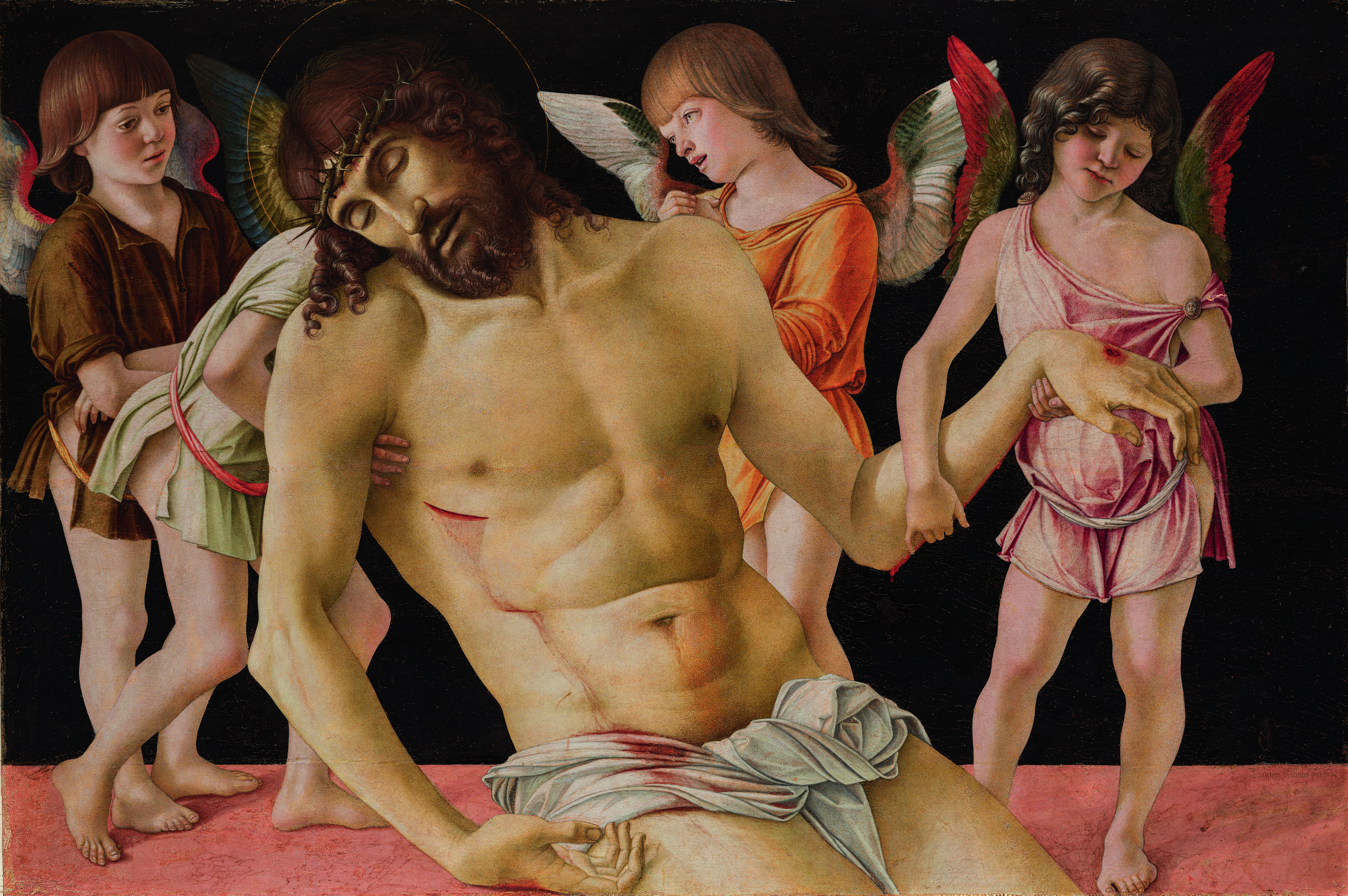
Commissioned around 1470, presumably by Rainerio di Ludovico Migliorati, a counselor to the Malatesta, Bellini’s panel was entrusted to the skilled hands of CBC’s restorers after a troubled history. It had already undergone two interventions by Mauro Pelliccioli and, in the 1960s, the bold removal of its severely deteriorated wooden support, carried out by Otello Caprara and Ottorino Nonfarmale—one of Bergamo Rossi’s own masters. “From a structural standpoint they did exemplary work; the aesthetics could be remedied: where the paint had fallen away, neutral stucco appeared as was customary at the time, and a heavily oxidized varnish covered the surface. The recent intervention restored the original colors and compensated for the losses: the choice was for kind of restoration that could be appreciated by a wider audience, beyond connoisseurs or art historians.” [Ed. note: for an in-depth look at the restoration: La Pietà by Giovanni Bellini restored by Venetian Heritage, Marsilio Arte].
This work is one of the many treasures in Venice that have benefited from private money—the Comitati Privati Internazionali per la Salvaguardia di Venezia, after all, boast a long tradition in the Lagoon. The case of Venetian Heritage is particularly significant, thanks to its vast campaign of restorations which over twenty-six years has encompassed sacred buildings, goldsmith’s works, wooden furnishings, paintings, and sculptures by the great masters of Venetian art. Today its generous efforts extend beyond individual masterpieces, embracing complex projects aimed at Venice’s state museums: “Not only what lies within the shell, but the shell itself.”
A turning point came in 2019 with the Domus Grimani project, the splendid adorned residence restored to its former glory. “A little over two million euros was enough to complete works that had never been finished and to bring back a substantial part of Giovanni Grimani’s collection to its home.” This made it possible to reinstall the Tribuna—the Roman-style room of the palace, a unique feature in Venice—which has since become the museum’s emblem and a must-see in the city.
Now, when Bellini’s masterpiece departs for the celebrated Morgan Library & Museum in New York (January 15 – April 19, 2026), before returning to Rimini where it will be temporarily joined by Saint Sebastian, the Ca’ d’Oro will close its doors until May 2027 to complete the renovation of the entire building—a major undertaking financed by the Foundation with €8.5 million, while an additional €1 million in ministerial funds will provide for the new entrance.
Born out of the Save Venice diaspora at the end of the 1990s, Venetian Heritage began with a distinctly New York imprint: a group of old-guard philanthropists led by Lawrence (Larry) Lovett, former chairman of the Metropolitan Opera at Lincoln Center. At the time, Toto Bergamo Rossi—then running his own restoration company—collaborated with them as an advisor; it was he who suggested the organization’s name. “The idea was to shift attention beyond the insular borders of the Serenissima, looking instead to its broader historical legacy,” he explains. Indeed, in 2009 the Foundation restored the Chapel of the Ark of Saint Anthony in Padua; while between 2000 and 2007 its work extended to the Dalmatian coast, to the cities of Trogir and Split, once part of the Venetian Republic. In that war-scarred region, the Foundation also helped train new generations of restorers through workshops and scholarships in collaboration with UNESCO.
Sixteen years ago Lovett handed the reins of Venetian Heritage to Bergamo Rossi who, having sold his company, became the driving force behind a patronage infused with international glamour yet guided by a practical vision of how things get done—and by a clear sense of the key to successful fundraising: “We dedicate at least a year to preliminary studies and pore over every detail so that, once the work begins, there are no surprises: accurate information and promises kept. Only then do donors return.”
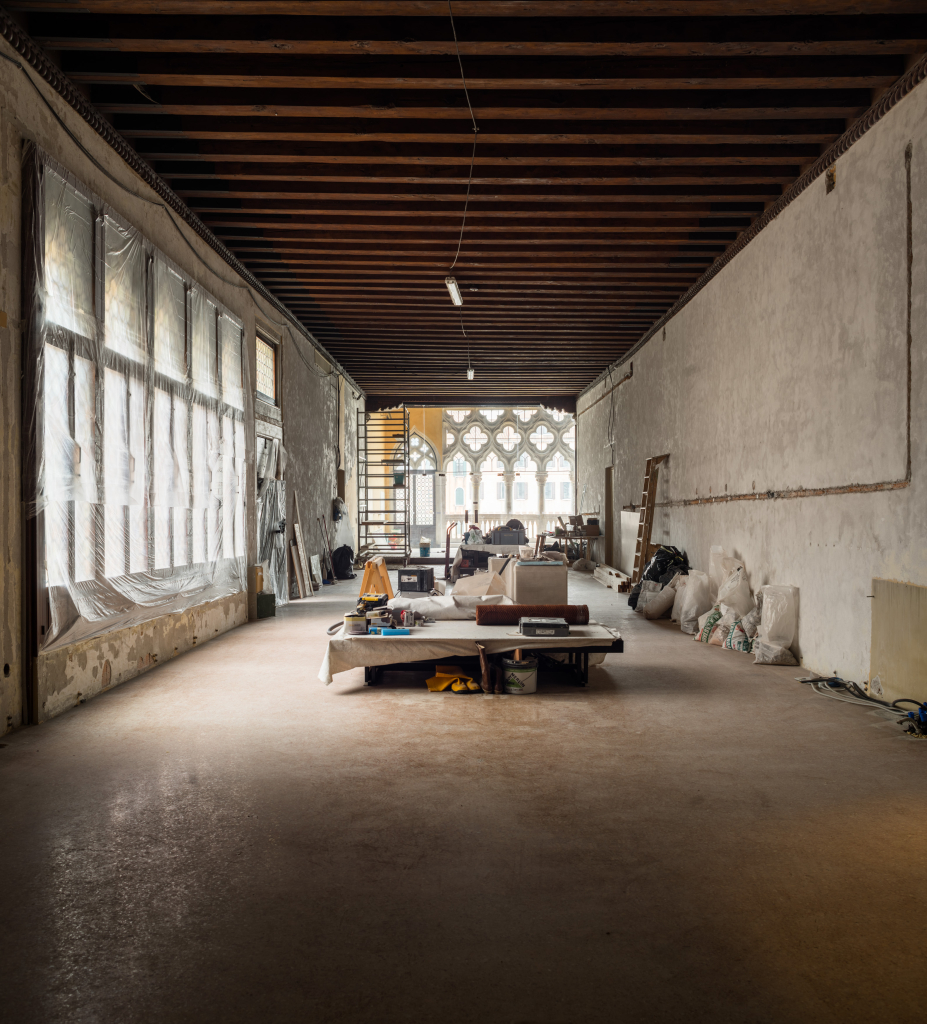
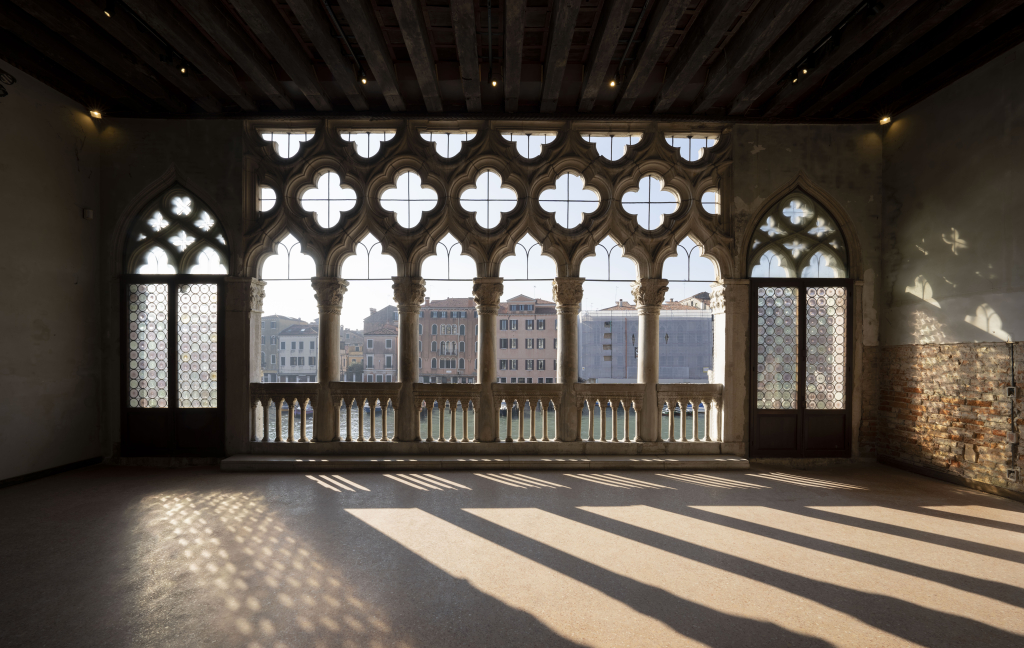
Balancing high society with the construction site, the director organized fundraising for the Ca’ d’Oro room by room, managing to allocate resources even to the “less glamorous” aspects of the project: from the septic tank to glass fitted with PVB film to block UV and IR rays, all the way to sophisticated and costly climate-control machinery (naturally invisible). At the same time, the redesign of the interiors is restoring the Scarpa-inspired plan devised by architect Mario Semino in the 1970s, whose foundation was Baron Franchetti’s private collection.
As before, Venetian Heritage has also made new acquisitions for the Ca’ d’Oro, including a pair of angels by Giorgio da Sebenico. “They once belonged to Pierpont Morgan, who donated them to the MET, where they remained in storage awaiting attribution, until the American museum decided to part with them. A member of our scientific committee spotted them at Bruno Botticelli’s stand at Frieze Masters and alerted us.” [Editor’s note: here is the link to our report on the 2025 edition of Tefaf].
In the Anglo-Saxon context from which Venetian Heritage originates—today structured across two offices and administrations, in the United States and in Venice—the principle holds that “if you succeed, if you’ve made it, at some point you must give back.” As Bergamo Rossi explains, this responsibility extends to culture. Thus the Foundation’s work also encompasses promotion: organizing exhibitions and producing publications to tell the story of its projects. “Years ago a friend told me: ‘Toto, you do wonderful things but nobody knows about them, you need to be inclusive.’ At first I was only interested in saving the works—I had never thought about it,” he concludes, “but today it’s essential for me to provide the keys of access. Because this heritage belongs to everyone.”
17 December 2025