
Lorenzo Lotto is always elsewhere: in the restless geography of his life, spent between Venice, Treviso, Rome, Bergamo and the Marche, and still today, in the scattering of his works across altars, sacristies, civic galleries and major international museums. No single collection can contain him. To meet him, one must follow a discontinuous map, moving from the half-light of a church to the brightness of a museum gallery, crossing major cities and outlying towns. The artist’s movements are echoed in a second biography: that of the paintings, shaped by long periods in one place, relocations, dismemberment, sales and far-off destinations.
Reconstructing these histories is a task that art historians have long pursued with patience: tracing provenance, recognising fragments, searching for missing parts and restoring the relationships the works have lost. Travel complements this knowledge, turning it into experience. What do a painting’s dimensions, its material qualities, its distance from the altar and its relationship to other images add to our understanding? Lotto’s geography invites us to travel for this reason too: each place reveals something that remains less apparent elsewhere.
The way the works are spread has helped to establish two prevailing images of the artist. In Italy, especially in the cities where he worked, Lotto emerges as the painter of monumental altarpieces made for confraternities and civic communities. In European and American museums, we more often come across the portraitist, the painter of images for private devotion and the inventor of enigmatic allegories. These are emphases that intertwine, not separate identities. A portrait, too, belonged to a social network; an altarpiece, too, could harbour an uneasy intimacy. Yet the different histories of preservation have shaped the way Lotto has been viewed and discussed.
In the Marche, the relationship between the works and the region is particularly strong. Lotto worked here at different stages of his life and eventually chose to retire here, becoming an oblate of the Holy House of Loreto. Ancona, Cingoli, Jesi, Loreto, Mogliano, Monte San Giusto, Recanati and Urbino form a constellation that no museum couldreproduce. To journey through it is to come upon a network of commissions, devotional practices and civic attachments. Lotto’s works were spread across the region before they were dispersed by history. Marta Paraventi has devoted a study to these later dispersals, La dispersione delle opere di Lorenzo Lotto dalle Marche (The Dispersal of Lorenzo Lotto’s Works from the Marche), in Lorenzo Lotto. Contesti, significati, conservazione, edited by Francesca Coltrinari and Enrico Maria Dal Pozzolo (2019).
In the church of Santa Maria in Telusiano at Monte San Giusto, the Crucifixion (1531) retains the power of an image conceived to act within a space of worship. The figures crowd at the foot of the crosses while the landscape opens behind them like an expanse that cannot be crossed. Grief runs through bodies, gazes and gestures. The breadth of the painting compels the eye to move, to search for a face, to return to a group. The relationship between the painted surface, the altar and the viewer’s position conveys a sense of scale that photography, by making everything simultaneously available, tends to diminish.
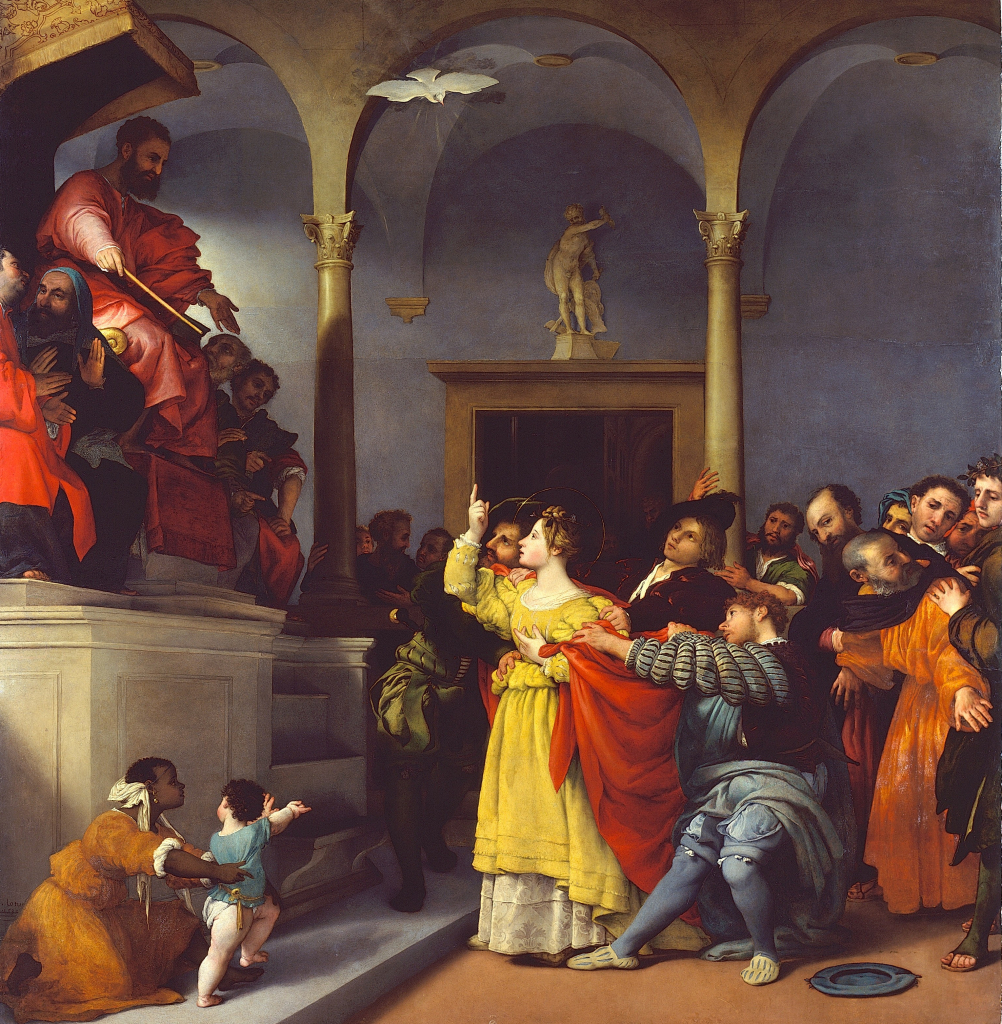
The Santa Lucia Altarpiece (1532), now in the Civic Museums of Palazzo Pianetti in Jesi, has had a different fate. Commissioned by the Confraternity of Saint Lucy for the church of San Floriano, it has left its liturgical setting, but not the city that wanted it. The museum offers a different kind of closeness: it invites us to follow the episodes and observe how gestures connect figures and moments in the narrative. The loss of the original function coexists with a new opportunity for attentive looking. To visit Jesi is to understand this transformation too, within a city that continues to recognise itself in the work.
Bergamo offers another experience of continuity and separation. The San Bernardino Altarpiece (1521), the Santo Spirito Altarpiece (1521), the fresco cycle in the Suardi Oratory (1524) at Trescore and the wood intarsia panels in the choir of Santa Maria Maggiore (1524–1532), executed by Giovan Francesco Capoferri from Lotto’s designs, form an ensemble spread across several sites. To understand it, one must move between spaces and alter one’s posture and viewing distance: look up at an altarpiece, follow a narrative along a wall, draw close to the intricacy of an intarsia panel. The route shows the varied circumstances in which Lotto responded to commissions from merchants, clergy and confraternity members.
The Martinengo Altarpiece (1513–1516) shows how a work can remain in a city yet still be displaced. Commissioned for the Dominican church of Santo Stefano, it was moved to the church of Santi Bartolomeo e Stefano after the original complex was demolished during the construction of the Venetian walls. The main panel is still in Bergamo and still with the Dominicans, but it no longer occupies the space for which it was conceived. The three predella scenes are at the Accademia Carrara. The city preserves the principal parts of the altarpiece in different locations: following the relationships between them means crossing the city.
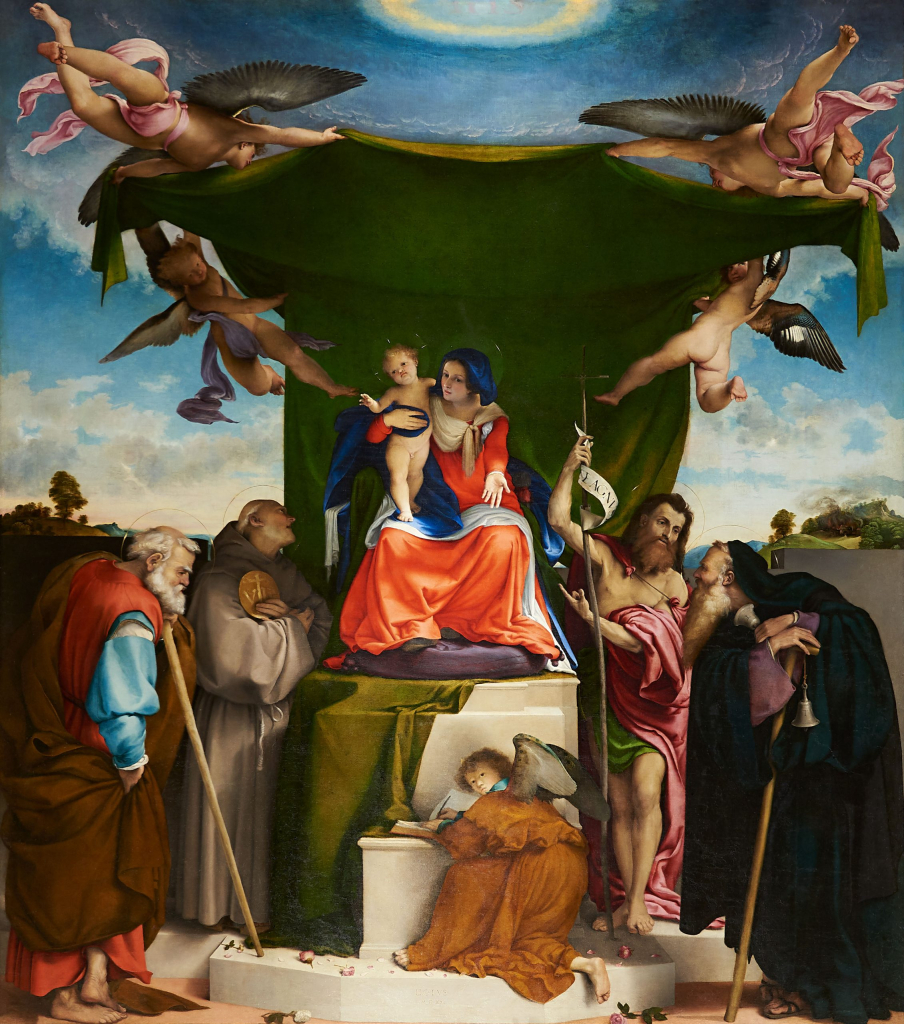
This route gives tangible form to an issue that art-historical reconstruction helps us understand. Seen up close, a predella reveals details that would be difficult to discern in its position on the altar; at the same time, its isolation makes its role within the whole less readily apparent. Visiting both church and museum allows us to keep both conditions in mind. We gain closeness, but must reconstruct a relationship. Even the time between visits to the two places becomes part of the encounter with the work.
Outside Italy, the art trade and international collecting have helped bring portraits, allegories and small-scale devotional paintings into collections abroad. This selection has fostered Lotto’s reputation as a painter of uncertain identities, allusive objects and hands that seem to reveal what the face withholds. Bernard Berenson’s 1895 monograph played a decisive role in Lotto’s modern rediscovery, recognising in him a sensibility capable of registering the soul’s changing states. As Simone Facchinettihas shown in Berenson giovane e vecchio, due diverse visioni di Lotto (1895 e 1955) (Young and Old Berenson: Two Different Visions of Lotto, 1895 and 1955), in the same 2019 volume, this interpretation was subsequently revised and reconsidered.
The history of reception therefore calls for caution: the sense of inwardness in Lotto’s paintings belongs to the works themselves, but the way they are displayed can heighten it. A face isolated in a gallery, far from the family and professional circumstances in which the portrait was painted, prompts different questions. Research recovers names and relationships; painting makes them present in the tension of a hand, in the texture of a garment.
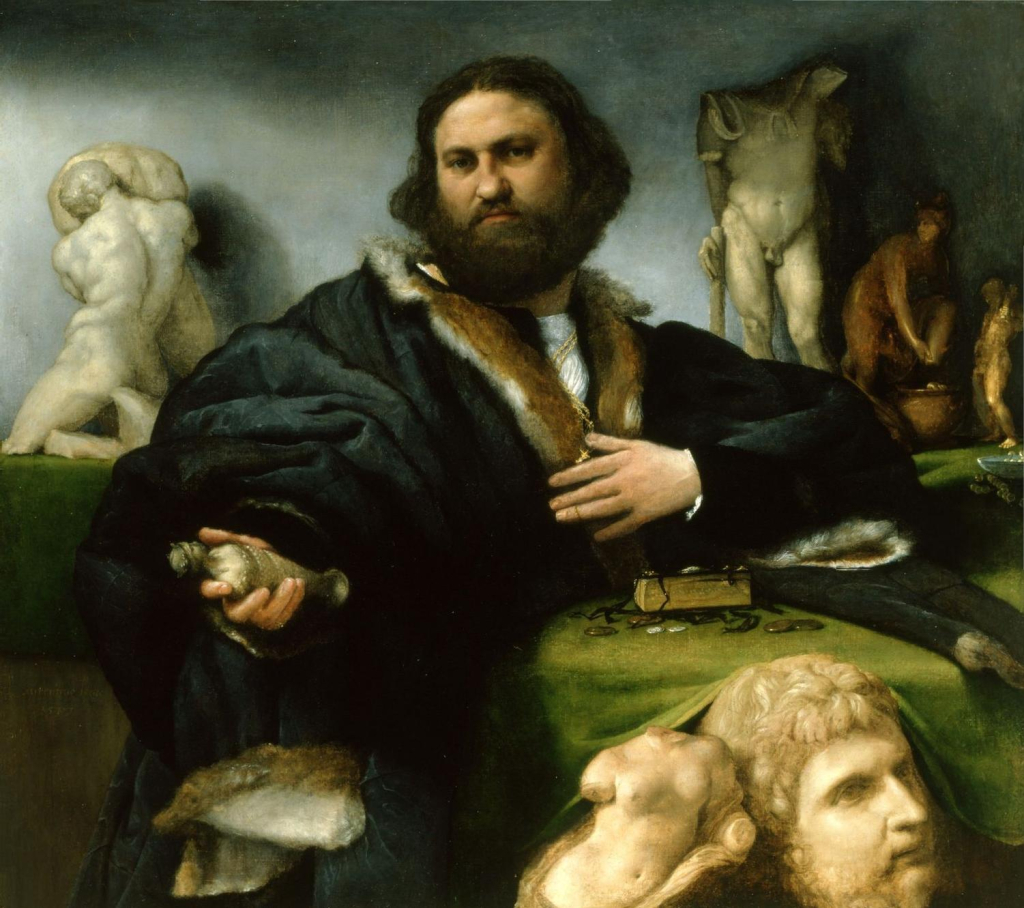
In the Portrait of Andrea Odoni (1527), in the Royal Collection, the Venetian merchant is surrounded by fragments from his own collection of antiquities. One hand offers a statuette; the other rests on his chest. Recorded by Marcantonio Michiel in 1532 in Odoni’s bedchamber, the painting formed part of a private setting and a learned conversation. It entered the English royal collections in 1660 as a gift from the States of Holland and West Friesland to Charles II. Its passage from a merchant’s house to a dynastic collection adds another history of ownership to its journey: the depicted collector himself becomes part of a collection.
At the Prado, Messer Marsilio Cassotti and His Wife Faustina (1523) brings a story from Bergamo to Madrid: the marriage of the son of Zanin Cassotti, who commissioned the painting. Cupid places a yoke over the couple’s shoulders; Marsilio slips the ring onto Faustina’s finger. In the museum housing the Spanish royal collection, these gestures preserve the memory of a family pact made far away. The museum setting also allows the portrait to be understood within a European history of social representation.
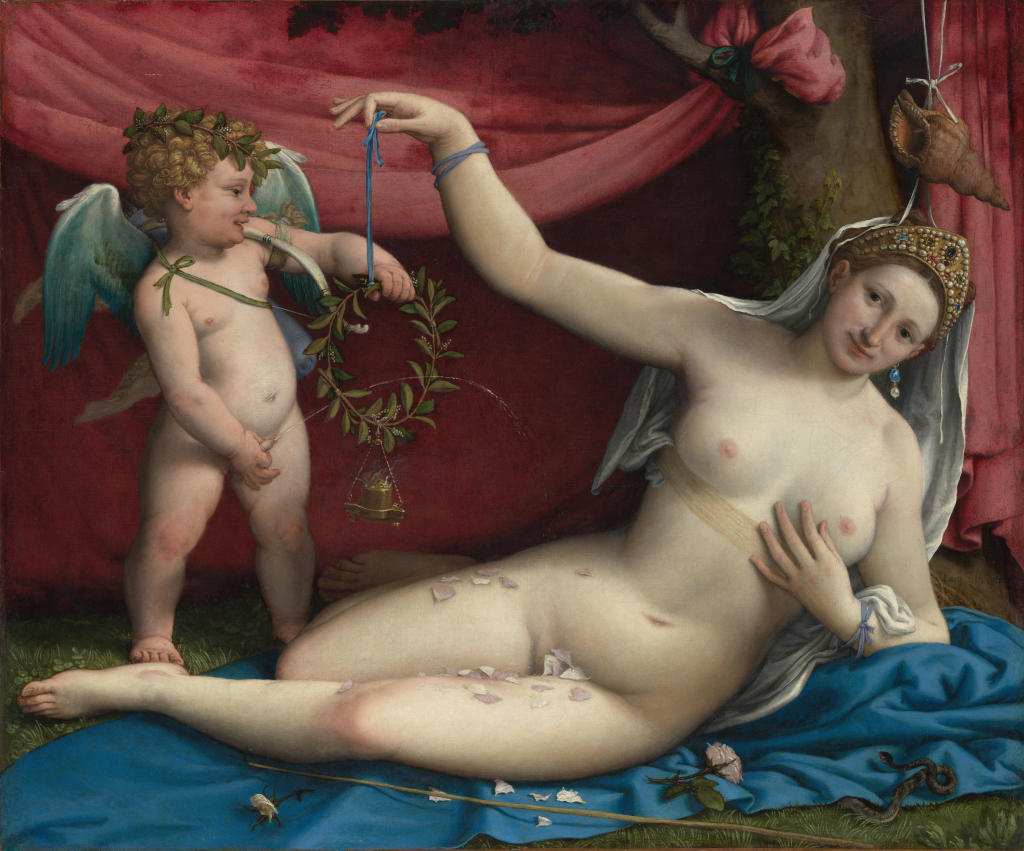
At the Metropolitan Museum of Art in New York, Venus and Cupid(1520s) transposes the theme of marriage into allegorical eroticism. Cupid urinates through a wreath in a gesture meant to bring fertility; Venus’s features may allude to the bride. Displayed among the European paintings, the work preserves traces of its original domestic setting within an encyclopaedic museum. The veil, the diadem and the pearl earring connect the myth to the adornments of Venetian brides: details through which a private life resurfaces within a major international collection.
The Portrait of Bishop Bernardo de’ Rossi (1505) and the Allegory of Virtue and Vice (1505) make clear the need to consider together works that are now far apart. The portrait is at Capodimonte; the allegorical panel that served as its cover is at the National Gallery of Art in Washington. The bishop’s face and the moral landscape belonged to a pictorial arrangement in which the symbolic image preceded the appearance of the sitter. Their separation has also altered this sequence of viewing.
In Naples, the portrait presents itself in its full intensity; in Washington, the allegory invites us to explore a landscape divided between virtue and vice. Reconstructing their original relationship prevents us from treating them simply as self-contained images. Briefly reunited at the National Gallery in London in 2018, the two panels allowed viewers to trace the correspondences between them. Exhibitions offer such provisional encounters, in which a relationship studied in books becomes perceptible again through the simultaneous presence of the works.
To follow Lotto is to accept that no visit is conclusive. A church helps us understand the viewing distance and intended setting of an altarpiece; a museum brings details, comparisons and separated parts within reach. Each encounter adds something and leaves open the need for the next. Between Bergamo and the Marche, Naples and Washington, knowledge grows through documents, reconstructions and journeys. Seeing the works in person gives these relationships a physical dimension: that of our body before the painting, the time we give it and the places we continue to travel through, carrying their images with us.
15 October 2026