
At first sight, this young woman, with her long ringlets and dress in the most elegant fashion of the 15th century, might seem an unlikely Virgin Annunciate. Yet her arms crossed over her breast and her gently bowed head identify her unmistakably as Mary humbly accepting the divine will with the words ‘Ecce ancilla Domini…’. One need only recall Giovanni Antonio Amadeo’s terracotta Virgin Annunciate on the lavabo in the smaller cloister of the Certosa di Pavia. The worldly character of the Virgin’s dress, too, has ample precedent in 15th-century Lombardy, where artists were particularly inclined to set episodes from sacred history amid the trappings of contemporary aristocratic life. A case in point is the Virgin Annunciate painted by Giovan Pietro da Cemmo in 1486 in the church of San Rocco at Bagolino, her hair elegantly braided and coiled on top of her head.
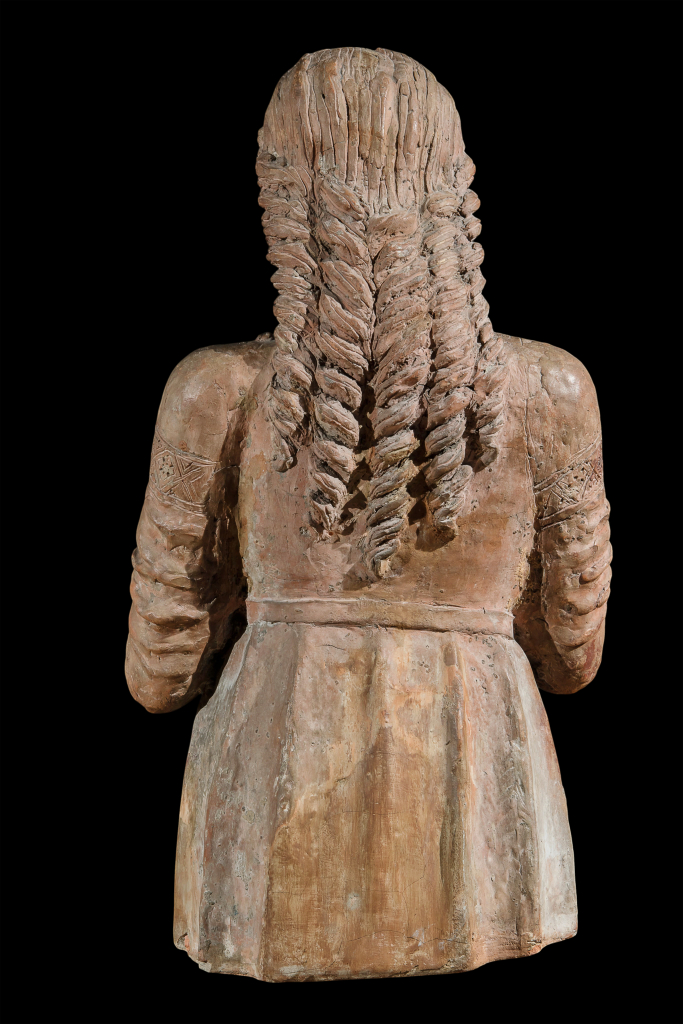
It is difficult to say whether the sculpture was conceived as a half-length figure or, as seems more likely, whether a second block of clay originally formed the lower body. In the latter case, the join between the two sections would have been concealed beneath the gesso ground and the polychromy. In either case, the Virgin would certainly have been paired with a figure of the archangel Gabriel delivering his message.
The work immediately brings to mind the extraordinary flowering of terracotta sculpture in Lombardy in the 1460s and 1470s. At the heart of this development was the building campaign at the Certosa di Pavia, where numerous sculptors were called upon to furnish the monastery’s two cloisters with a profusion of angels, busts of prophets, friezes and festoons. A leading figure among them was Francesco Solari, a member of a family from the Ticino region renowned for its work in sculpture and architecture. Francesco’s father, Giovanni, and his brother, Guiniforte, were both architects. The surest guide to Francesco’s style is a group of four terracotta candle-bearing angels made in 1466 for another of the most ambitious building projects in 15th-century Lombardy, the Ospedale Maggiore in Milan. Originally placed on the piers of the hospital’s cross-shaped central ward, they are now in the collections of the Castello Sforzesco.
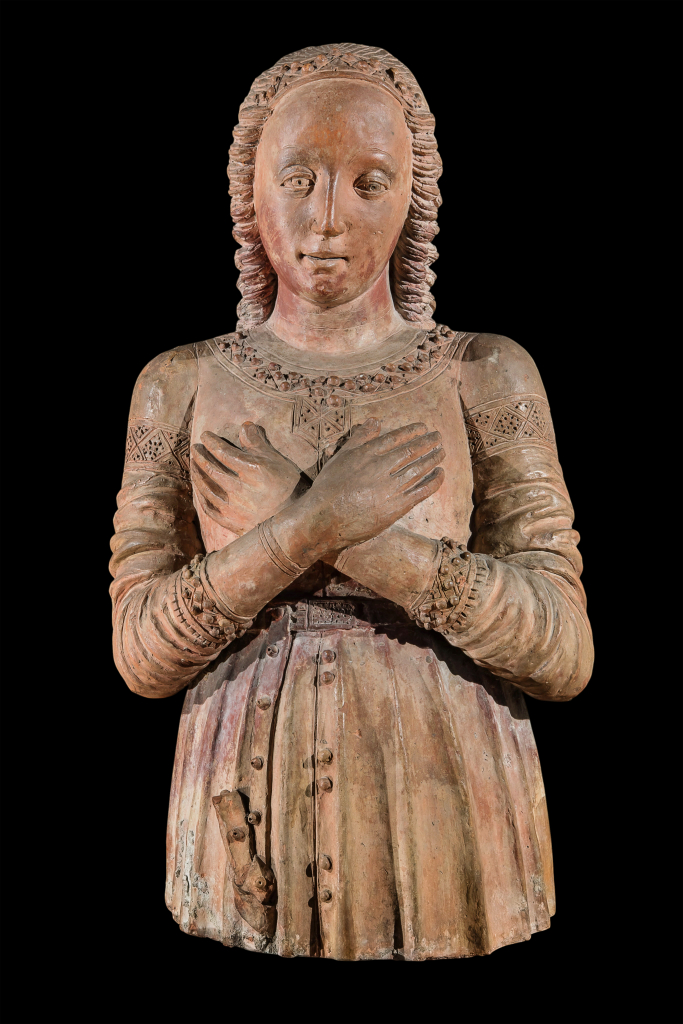
The present Virgin Annunciate has much in common with these four striking figures, which still preserve some of their original polychromy, a rare survival. She shares their full, perfectly oval faces and large, strong hands. Even such unusual details as the sleeves gathered into a dense succession of tightly pinched folds recur here in precisely the same form.
These affinities place the Virgin Annunciate in Lombardy in the same years and within the orbit of Francesco Solari. The angels in the Castello Sforzesco are modelled with greater freedom, especially in their masses of curls. The most accomplished of the four has a vitality that suggests Solari may have worked alongside his most gifted pupil, Giovanni Antonio Amadeo, who would soon become the foremost sculptor in the Duchy of Milan (see Vincenzo Foppa. Un protagonista del Rinascimento, exhibition catalogue, Brescia, Milan, 2003, p. 162).
Much of the present terracotta’s charm lies in its gentle smile and its sculptor’s evident delight in ornament. These qualities bring to mind two anonymous modellers, known from their most characteristic works as the Master of the Singing Angels and the Master of the Madonna of the Mouse (see Aldo Galli, ‘Il Maestro degli angeli cantori e le più antiche sculture lombarde in terracotta’, Nuovi Studi. Rivista di arte antica e moderna, 6, 1998, pp. 15–30). The Master of the Singing Angels probably began his career in the first half of the 15th century and remained in many respects indebted to late Gothic taste. He worked principally around Brescia and Crema, where the largest group of his works survives, although many have long since found their way into museums in Paris, Berlin and London.It has recently been tentatively proposed that he be identified with Fondulino de Fondulis of Crema, the father of the better-known Renaissance sculptor Giovanni de Fondulis (see Marco Scansani, Il fuoco sacro della terracotta. Giovanni de Fondulis tra Lombardia e Veneto, Mantua, 2023, pp. 41–48). At his best, the master handles clay with remarkable freedom, and his expressive modelling sometimes verges on the grotesque or caricatural. A characteristic example is a relief of rather mysterious subject in the Museo di Santa Giulia in Brescia, in which a female saint stands among a group of plague sufferers. The elegant young woman’s fashionable dress is exuberantly ornamented. Her pearl-trimmed neckline, fashioned from tiny pellets of clay pressed lightly into place, is an especially close parallel to that of the present Virgin Annunciate.
The affinities are closer still in the Master of the Singing Angels’ later works, which are more restrained, solemn and monumental. In particular, the full, fleshy face of the present Virgin, with its high forehead, small rounded chin and sharply arched eyebrows, compares closely with that of a large Madonna and Child with Two Angels in the Bode Museum in Berlin.
The Master of the Madonna of the Mouse drew directly on the style of the Master of the Singing Angels and was in all likelihood his pupil. Active in the 1460s and 1470s, the sculptor owes his curious name to a handsome shrine now set into a courtyard wall at Palazzo Bagatti Valsecchi in Milan, apparently from an old tavern in the neighbourhood (see Maria Luisa Gatti Perer, ed., Milano ritrovata. L’asse di via Torino, Milan, 1986, p. 356). Within an imaginatively designed architectural niche, the Virgin sits enthroned with the Child on her lap. A small, now badly damaged animal peers over his shoulder. Local tradition took it for a mouse, and the work is known in Milanese dialect as the Madonna del ratt. The bushy tail suggests a dormouse, or possibly a squirrel.
The Madonna of the Mouse, whose drapery still falls in Gothic rhythms, is the earliest sculpture that can be attributed to this master. His fondness for decorative elaboration is already apparent. The borders of the Virgin’s mantle and the Child’s sleeves are incised with a modelling tool to suggest embroidered bands, while the shrine itself bristles with foliage, shells and pinnacles.
The same taste for ornament marks the master’s mature works, by then fully Renaissance in character. Chief among them is a large two-tier polyptych in the church of Santo Stefano at Mozzanica, between Crema and Bergamo (first published by Winifred Terni De Gregory, Pittura artigiana lombarda del Rinascimento, Milan, 1958, p. 18). Terracotta polyptychs must have been fairly common in Lombardy in the days of Francesco and Gian Galeazzo Sforza, though changing tastes and liturgical requirements have left scant traces of them. The Mozzanica altarpiece is therefore of considerable historical importance, even though its colour has been lost. A similar ensemble by the master once stood in the Dominican church in Monza. Several of its elements survive in the city’s Museo del Duomo, and a compartment from a further polyptych, depicting Saint Dominic, is in the Castello Sforzesco in Milan.
The Madonna of the Mozzanica polyptych, with the shy smile playing across her full, oval face, is particularly close to the present Virgin Annunciate. The sculptor’s familiar decorative flair is evident in the incised ornament of her dress and in the treatment of the arches above the niches. The resemblances extend to the smallest details. The Mozzanica Madonna’s belt is studded with little clay pellets, and its hanging end is knotted in exactly the same way in the present sculpture and in a figure of the Virgin Annunciate from the Monza polyptych.
The identity of hand is beyond doubt. This sculpture can thus be attributed to the Master of the Madonna of the Mouse, at a stage in his career between the shrine in the Museo Bagatti Valsecchi, datable to around 1460, and the Mozzanica and Monza polyptychs of about 1475–80. The latter are the master’s most distinctly Renaissance works, as passages of sharply angular drapery show, with a hint of Mantegna in their emphatic folds. Yet at Mozzanica, as in the terracottas in Monza and the Castello Sforzesco, there is a perceptible falling-off in quality. The Madonna of the Mouse and the present Virgin Annunciate are striking for their lively eyes, ringleted hair, athletic, broad-shouldered figures and the faint smile at their lips. In the later terracottas, the modelling loses some of its freshness, becoming more schematic and at times rather flat. This may have had something to do with the provincial commissions for which these works were made, or with a tendency towards repetition in the closing years of the anonymous sculptor’s career. This terracotta shows the Master of the Madonna of the Mouse at the height of his powers and confirms his significance among the terracotta sculptors of Renaissance Lombardy whose complex relationships have yet to be fully explored.
Ndr. This study was commissioned from the author by Longari Arte Milano to coincide with the exhibition ‘A Girl from the Lombard Renaissance’, which is being held at the gallery from 12 November 2026 to 31 January 2027.
11 November 2026

