
Although tracing the origins of the Cesati family’s passion for collecting may not be straightforward, the instinct of the connoisseur and a lifelong engagement with the arts have always distinguished their lineage. In more recent times, Alessandro Cesati recalls a great-grandfather, a lawyer, who in the early 20th century was actively involved in Milan’s cultural life and counted Medardo Rosso among his friends; a grandfather who was a conductor; and his own father, who developed an interest in art and the market from a young age.
Inevitably, this “fascination with art in all its forms” found its outlet in the antiques trade during the 1980s, enabling Alessandro and his father Fiorenzo to raise the bar. “While a collector is eventually forced to stop—whether for reasons of space or finances—being an antiques dealer allows one to continue collecting at an ever higher level,” Cesati explains. Indeed, just as there are collector-dealers (more common in the contemporary art world), there are dealer-collectors. But Cesati deliberately uses the term “antiquarian,” emphasising its cultural dimension: “We consider ourselves such insofar as we have enjoyed—myself especially—studying, delving deeper, and classifying.”
Milanese for five centuries, the Cesati family found themselves—quite incidentally—in Bergamo around the mid-20th century, “the westernmost edge of the Republic of Venice,” where, just steps from the Accademia Carrara, Mauro Pelliccioli, the greatest restorer of his time, was at work. “I enjoy recounting this anecdote,” says Alessandro Cesati. “One day, when Federico Zeri was asked who in Italy could truly lay claim to the title of antiquarian, he replied: ‘Who can rightly boast of being such? Lorenzelli in Bergamo and Apolloni in Rome; the rest, I do not know.’”
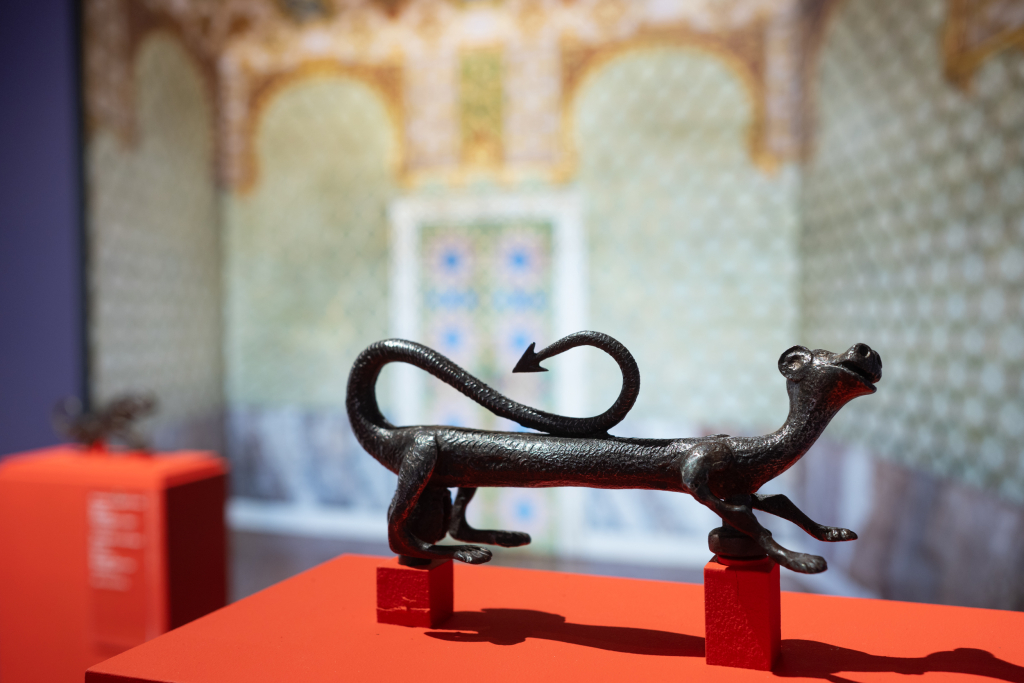
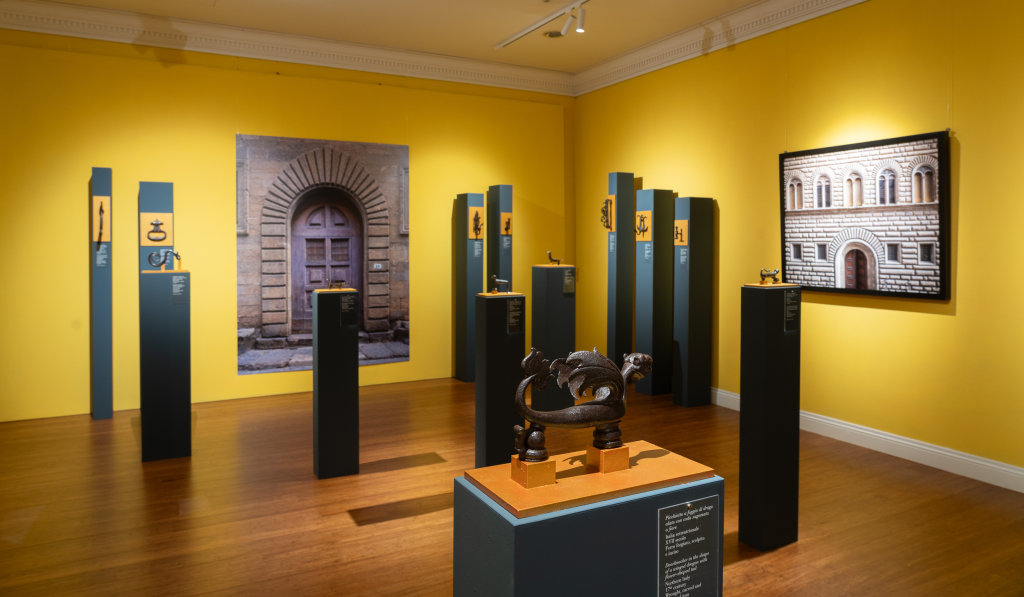
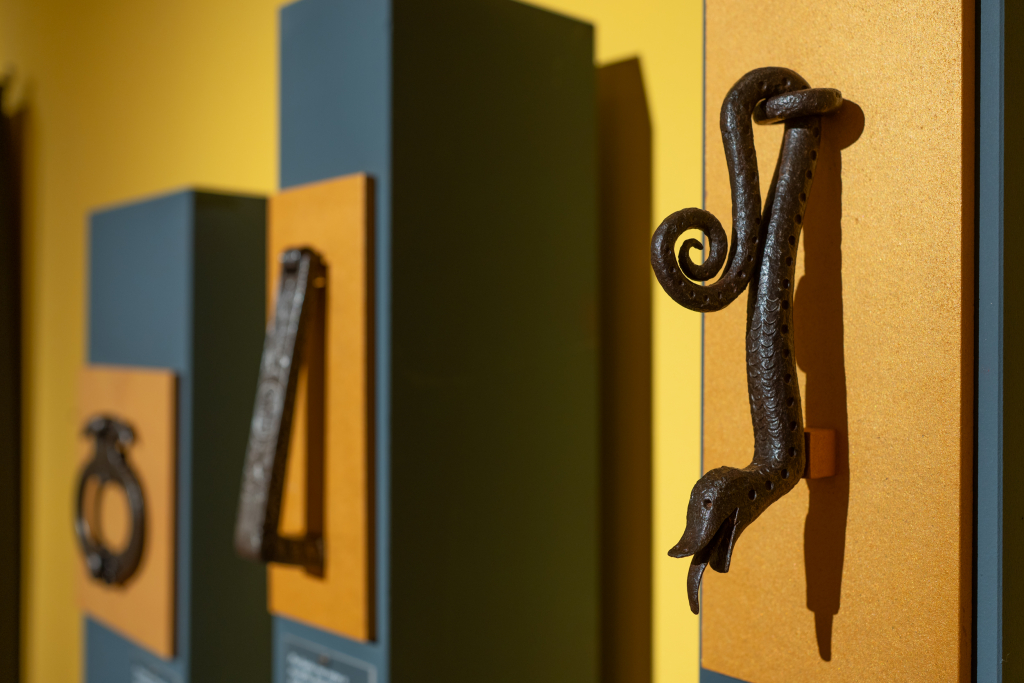
It was here, as a young boy, that Fiorenzo Cesati fell in love with the door knockers glimpsed on ancient portals while strolling through the streets of the Città Alta. The first piece was acquired in the 1970s, the most recent just a few years ago: a collection of 300 specimens, 65 of which are now on display in the exhibition Knock Knock Knock. Iron Guardians from the Cesati Collection, at the Labyrinth of the Masone in Fontanellato.
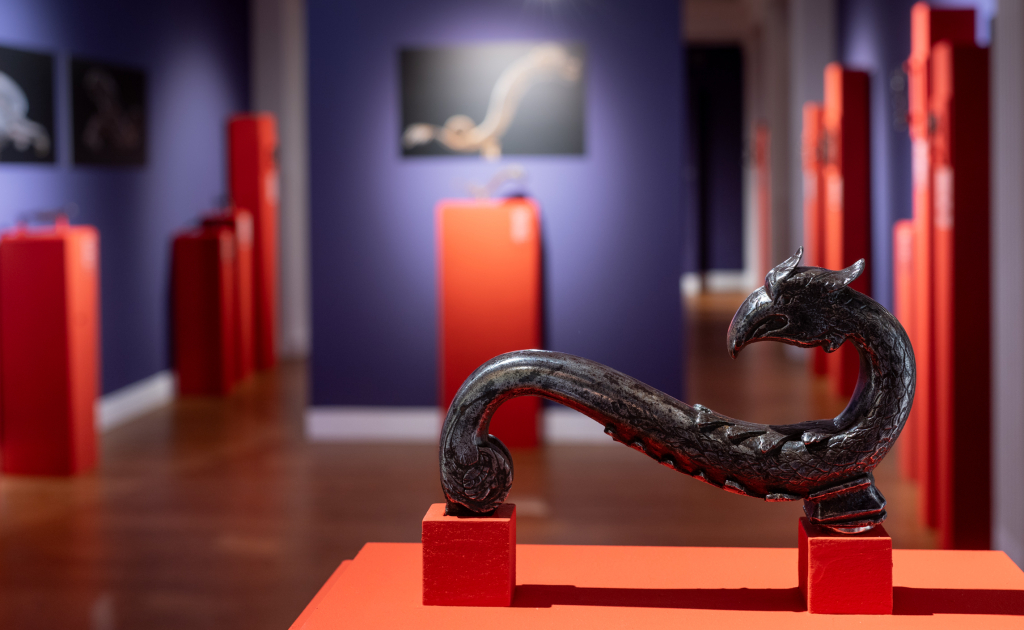
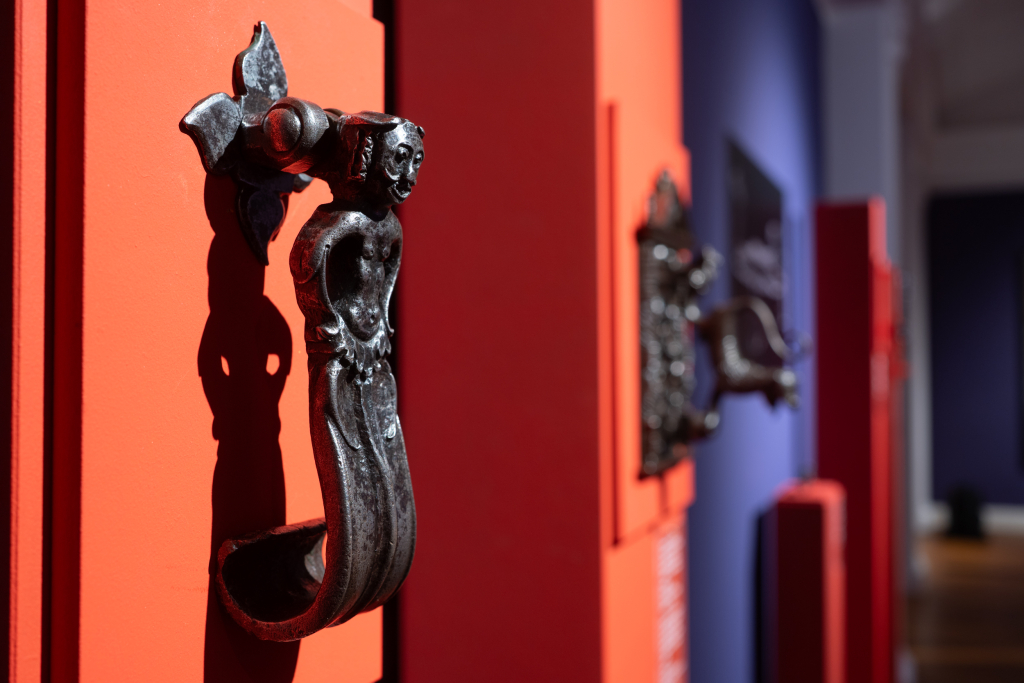
Floral motifs, anthropomorphic figures, and then serpents, dragons, fish, dogs. A bestiary emerges, flowing from the pre-Christian world into the Middle Ages—an era when the first intricately shaped door knockers began to be crafted, thanks to advances in ironworking techniques.
Some of the pieces on display boast—an exceptional rarity for objects of this kind—a distinguished provenance. Auctioned off sixty years ago, they once belonged to the collection assembled by the Mylius family, Alsatian industrialists who relocated to Lombardy in the 19th century. “The patriarch, Enrico, commissioned Hayez to paint a version of the famous Kiss. Two of his descendants—coincidentally, father and son—became enamoured with iron and went on to create one of the most extraordinary collections of door knockers ever assembled.” In 1905, they published a folio volume in a limited edition of 100 copies, showcasing 150 iron and 150 bronze knockers. “It’s a rare case of iron possessing a pedigree of over a century. There are photographs of their villa in Sesto San Giovanni, with a wall covered in knockers, alongside a Renaissance painting, majolica, chinoiserie—iron considered worthy of sitting beside works conventionally deemed superior.”
A pioneering attitude, yet also the product of a Northern European culture—prevalent across France and Germany—where the principal museums devoted to the so-called “applied arts,” or artistic-industrial museums, are naturally located.
“But there’s no doubt,” Cesati observes, “that behind the making of these objects—indistinguishable from small sculptures to the untrained eye—there lay an artistic intent. Of course, one must consider the level of quality. Still, I hear that in the Anglo-Saxon world, the distinction between art and applied arts is gradually and rightly disappearing.”That such distinctions are more conventional than factual is illustrated by another anecdote Cesati shares. In 1650, Louis XIV felt the need to redefine the hierarchy of the arts: painting, sculpture, architecture. And ironwork—the fourth art was ferronerie. Thus began, from the mid-17th century to the early 19th, a veritable craze: “All the nobility wanted to possess beautiful ironwork; the more daring even took pleasure in forging it themselves—French kings included, who were amateur ironworkers.”
To the broad lineage of iron artefacts and their finest historical examples, the Cesati family, together with Lorenzelli in Bergamo—who had managed to acquire a significant number of pieces from the dispersed Mylius collection—dedicated the 1991 exhibition Ferro Civile.
“It’s a frenzied and profound investigation into materials. You see, my father and I have often engaged with art historians. And while nine out of ten are brilliant at stylistic interpretation, they can still be mistaken—because if you don’t know the substance, the material, you won’t get there… style alone isn’t enough to determine the age of an object. One must understand wear, oxidation, erosion, engraving techniques. And that can only be learned by seeing a great deal.”
So, what is the “original sin” of iron, glass, wood, and so many similar crafts? Cesati reflects: “That there are no names or surnames—at most, a few initials. The makers were artisans whose biographies will never be found. Today’s collecting world chases the name: artists with catalogues raisonnés, whose lives are fully documented, and whose works, so to speak, carry no risk.”
Because, he admits with some regret, the notion has taken hold that art should be an investment. “For the past 30 or 40 years, the Americans have instilled the idea that one must, if not make a profit, at least invest wisely. But what does it mean to invest wisely? As if a work of art were a stock or a mutual fund… The value of these things should lie, first and foremost, in the pleasure of having them in one’s home.”
And what is it that interests Alessandro Cesati? “I’m interested in quality—that is, something that surprises me, that I’ve never seen before. Or something I have seen, in a museum, and which is therefore objectively rare. Finding one on the market is thrilling.”
Today, in an interconnected world with new wealth emerging from unexpected corners of the globe, an extraordinary piece is easily visible to all. Just as happened when he and his father identified a Habsburg strongbox, in iron and gilded brass, “of utterly unrestrained opulence”—clearly an object of great value. But how great? That’s the question, and that’s where the game is played. Because “if an object is of excellent, incomparable, and unrepeatable quality, then its value is written nowhere.”
10 November 2025